
The Memory Ceiling
Why Parameter Counts Might Hit a Wall (And What Comes Next)


Introduction
Kimi K3 has arrived with much benchmark fanfare with the team debuting a 2.8-trillion-parameter Mixture-of-Experts model. The nearly 3T parameter model is very large, so large in fact that it creates it’s own super class of open source model. Like most other large models it employs a sparse MoE design to avoid the computational cost of using every parameter on every inference step, yet the broader pool of weights must still be stored, distributed, and made rapidly accessible across the underlying hardware. K3 therefore raises a quieter but more consequential question: even if sparse architectures allow parameter counts to keep growing, are we approaching a practical limit to how large such models can be deployed and served economically? The answer may lie less in theoretical model design than in the physical capacity, bandwidth, and cost of memory itself.
The Physical Bottleneck
To run models of this magnitude, you need exceptional memory capacity. Modern inference-grade nodes—whether equipped with B300 GPUs (offering roughly 2.3 terabytes of VRAM), or the more expansive GB200 and GB300 architectures (boasting nearly 13 and 21 terabytes respectively) represent the current ceiling of single node capacity. But these systems are expensive and occupy a small fraction of existing datacenter capacity.
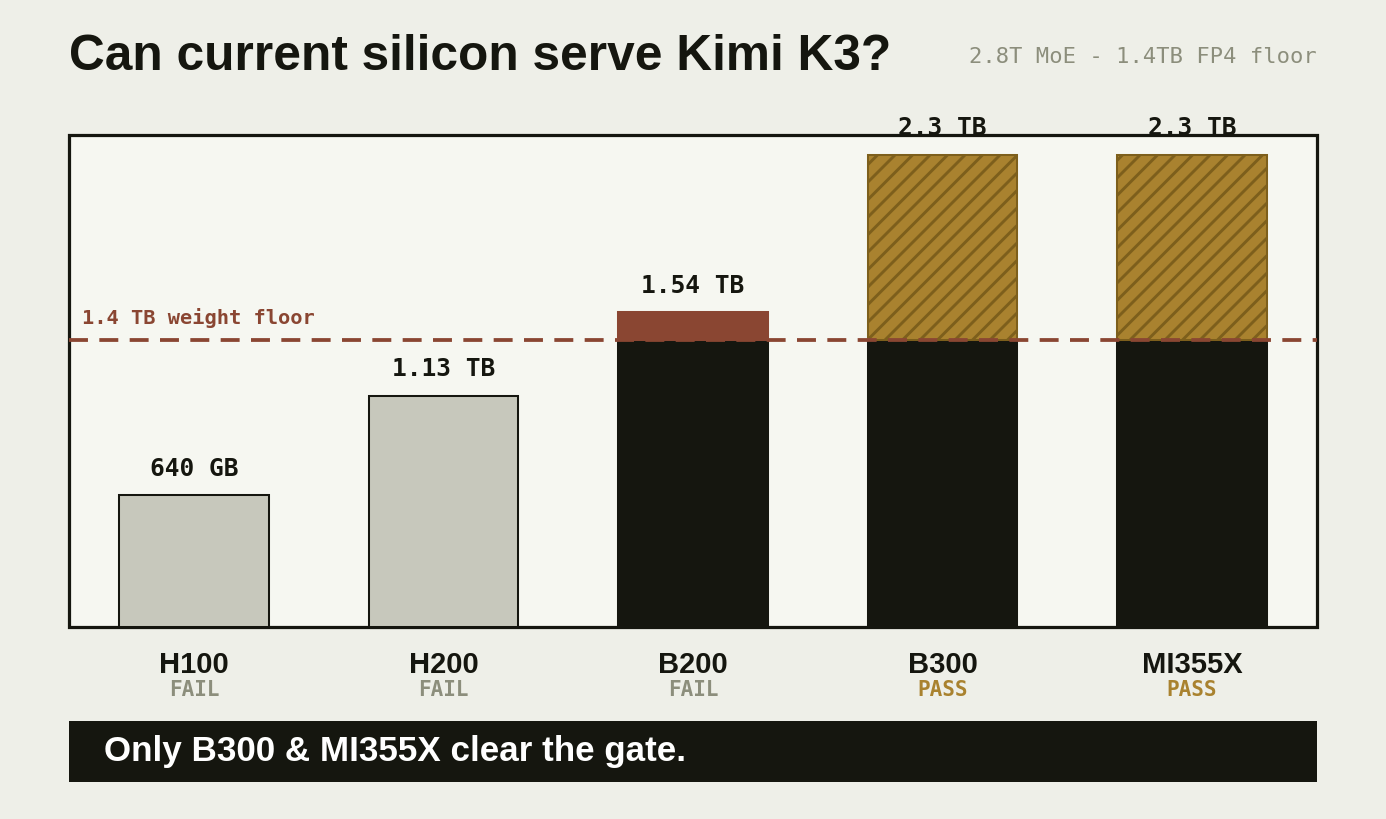
High-bandwidth memory is notoriously difficult to manufacture at scale. Unlike compute silicon, high-bandwidth memory cannot simply be scaled by adding more transistors. It depends on advanced 3D stacking, sophisticated packaging and a comparatively small manufacturing ecosystem. As a result, increasing memory supply is often slower and more capital-intensive than increasing raw compute performance. Even as new fabrication lines and memory suppliers come online, it could easily take twelve months or more before meaningful capacity reaches the broader market. Until then, the hardware capable of hosting these enormous weights will remain a scarce commodity. That scarcity naturally throttles widespread adoption, leaving only a narrow set of providers capable of serving models like Kimi K3 at scale.
The Quiet Shift in Inference Economics
This hardware limitation carries direct economic consequences. When only a handful of specialised nodes can comfortably fit a model’s weights, the logistics of serving it change fundamentally. Parallelisation becomes harder to maintain, KV cache space shrinks relative to the model footprint, and workloads often need to be sharded or partitioned across multiple machines. The overhead doesn’t disappear; it compounds. High density GPU nodes (GB200 and GB300) contain low latency high bandwidth interconnects specifically to address this problem, but combining multiple such nodes still incurs significant performance overheads.
Hardware architectures will continue to improve, but the more fundamental bottleneck is the industry’s ability to manufacture enough high-bandwidth memory. Process improvements and new production capacity will gradually increase supply, but those gains are likely to be incremental rather than transformative. In the meantime, the same constrained pool of memory must be divided across a growing number of accelerators and systems.
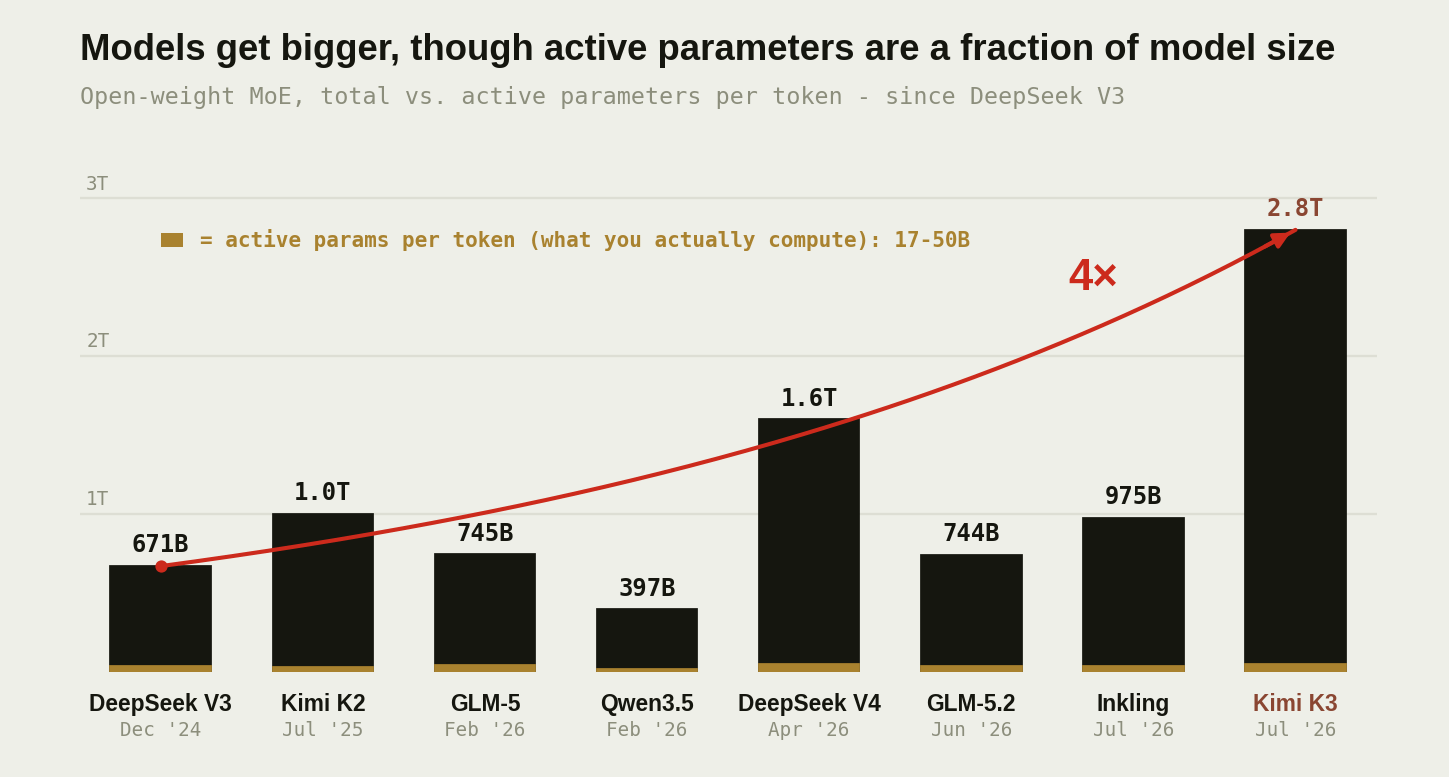
This creates an unavoidable trade-off. Manufacturers can concentrate more memory into a smaller number of high-density GPU clusters, making the largest models technically deployable but limiting how many such systems can exist. Alternatively, they can continue allocating broadly similar amounts of memory per GPU or node, preserving system availability while leaving the memory wall largely intact. Either way, total deployable capacity remains constrained by memory supply, and the economics of serving the largest models are unlikely to improve through better compute silicon alone.
Reaching the Edge of Brute-Force Scaling
Perhaps more importantly, we might be approaching the limits of what simply adding parameters can deliver. Historically, increasing weight counts has roughly correlated with improved reasoning, deeper context retention, and more reliable alignment.. but this is an oversimplification. Intelligence does not scale linearly with size, especially when the logistical friction of storing and serving those parameters begins to outweigh the marginal gains.
Without meaningful advances in how model weights are stored, compressed, or dynamically activated, continuing down this path could prove increasingly inefficient. Techniques like sparse activation, improvements in mixture-of-experts routing, novel attention mechanisms or purpose-built inference silicon might eventually ease the burden. But none of these solutions are guaranteed to arrive quickly enough to sustain an endless doubling cycle. At some point, the “brute-force” approach of packing more parameters into a dense matrix may simply stop yielding proportional returns, regardless of how much compute is thrown at it.
A Different Kind of Progress
The trajectory of AI development rarely follows a straight line, and the next phase may require a subtle pivot rather than another sprint toward bigger numbers. Parameter counts might plateau, not because researchers lack ambition, but because memory supply chains, hardware availability, and the economics of inference impose a quiet boundary.
That doesn’t mean progress will stall. It may simply mean that the field’s next meaningful leaps will come from architectural refinement, smarter memory utilisation, and more sustainable serving strategies. As we wait for open weights to drop and new silicon to gradually trickle into production, it’s worth considering whether the quest for ever-larger models is truly the most efficient path forward—or whether the future of AI lies in extracting more intelligence from leaner, more elegantly structured systems.
About Anera
Our goal is to continue to stay on top of the economics of inference. Every new model moves markets. We are lucky that we get to work with teams at the bleeding edge of frontier open source inference arming them with capital and compute to keep pace with the surging demand for tokens. If you are in the business of inference and need frontier compute, feel free to reach out!
contact@aneralabs.xyz